Showing posts with label Fall 2016. Show all posts

Wednesday, April 26, 2017

Don't Put The Plants To Sleep On The Ground

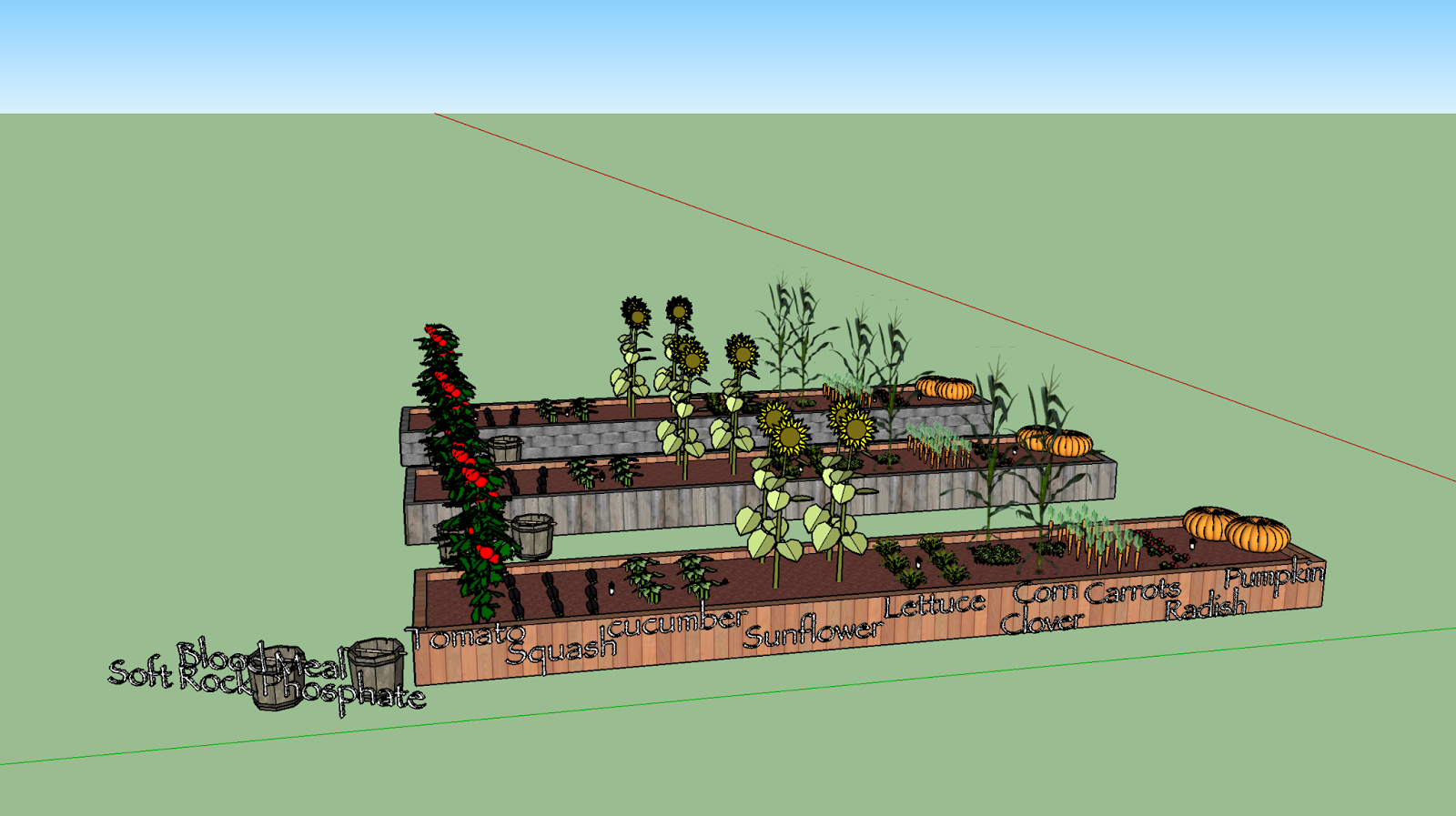
In the first unit of food class, we talked about food, where it comes from, how it gets to our table, and different ways that people across the world grow it from people like Fukuoka to Darwin. One thing that we focused on at the end of this section was different Garden types, how people grow their food, and companion planting and companion plants. For the Action Project, we had to design our own garden in any form, whether it be a raised garden to buckets, and then we had to choose the right plants to go together in the garden. Along with this, we had to figure out the different minerals and materials in the soil where we plan on planting our garden and figure out what supplements we had to use.


My garden will be in front of GCE Lab School on the sidewalk where people aren't walking. This is a great place to put a garden because it's long, wide, it has good dirt and it has lots of people that can take care of it. I chose this spot because I don't have anywhere else near my house to put a garden even on the sidewalk because there are so many things in the way. Also, the sidewalks aren't very wide at my house so this was an ideal location to put a garden.

The materials I used for this raised-bed are two by fours from the store, two by fours that are recycled and reused from anywhere and stone blocks from the store. I chose these materials because they're ideal for building a raised bed: wood is a cheap and reliable way to make it strong and sturdy, also stones are fairly cheap and make a very good and good-looking raised bed.

My soil quality was actually very good. The nitrogen level was 34, the potassium level was 245, and the phosphorus level was 11. Despite how good the quality of this dirt was I still had to add supplements. I added 11.25 pounds of blood meal to the dirt for Nitrogen. The way I figured out I needed 11.25 pounds of blood meal was by looking at a chart that showed that my nitrogen levels were high. This means that I would have to add 3 pounds per 100 square feet, so I did 3x3.75=11.25 pounds. For Potassium I do not have to add any supplements because I have the exact amount. I have 11 Phosphorus which is a decent amount but won't cut it. For the amount of phosphorus that I have, I will need to supplement it with 3 pounds of Soft Rock Phosphate per 100 square feet. I had to do the exact same equation as the nitrogen which is 3x3.75=11.25 pounds. I added these because without them the plants would not survive.

I will not be using any natural farming techniques because to be a natural farmer you need plants that aren't accustomed to being overwhelmed with pesticides and fertilizer. Unfortunately, you really cannot just buy these plants from the store. They have to become accustomed to nature and to not be supported by humans. I do not have the time or money to spend on plants that can't live by themselves. What I'm looking for is a garden that is more simple to take care of and is more average.

From this project, I have learned how to make a garden functional, how different plants can work with each other, and that Chicago does not have good soil quality. I do not plan to implement my garden only because I have 3 raised beds which are 25 feet long by 5 feet wide. All these gardens would be cool but they are not ideal things to have in Chicago since they are so large.

My raised beds are 25 feet by 5 feet by 1 & a half feet tall, each raised garden has 187.5 square feet of space. In total, I will need 562.5 square feet of dirt to fill all three gardens properly. The total surface area is 375 square feet because each garden is 25 feet by 5 feet which equal 125 which I have to multiply by three.

In conclusion, I have learned a lot about gardening, nutrients that plants need, and how they really thrive and live. Before this project, I didn't really know that plants needed so much care and work. Also after we visited the different gardens it taught me a ton about how much effort really goes into having a garden in the city. The people worked very hard on all the gardens and had everything from drainage pipes to nets over the plants. I don't think I would have enough time or drive to keep a garden running for long enough.

Monday, October 31, 2016

I am Malala

I took a class called MDGs. We learned about the 8 MDGs and the 17 SDGs. We also read the book I am Malala over the summer and we now are doing a project combining the book and the SDGs & MDGs. This project is about how Malala lived, fought and survived. I asked people for their thoughts on Malala and explained if I agreed or disagreed. I also said what six SDGs went along with the book and wrote why they corresponded with the book. I choose Gender equality, Quality education, Peace Justice, No Poverty, Good Health, Clean Water and Sanitation.

Friday, October 28, 2016

How is Hong Kong being affected by pollution?

The class I took was called Water. We learned about how important and scarce water really is. In this unit we learned about glaciers and how they provide a massive amount of fresh water for people around them. Unfortunately glaciers are melting at a fast rate due to global warming and they won't be around much longer. For this project we had to focus on a certain city and write about the future climate. I studied Hong Kong and learned about how there could be a catastrophe caused by global warming. We also learned about cloud types and where certain clouds form in the atmosphere. All of this content is in the project.


Friday, October 21, 2016

Are you for Women's Equality?


The class I took was MDG's and You. This class is about the 8 MDG's and one of them is women's equality. That's what this essay is about. We learned how women are objectified and how they are paid differently than men. There are many more subjects of inequality such as domestic violence, education, and military all these are covered in my essay.

Have you ever seen your father hurt your mother? Have you ever wondered how America's education for females compared with China's? Have you ever wondered how China’s military treats women in comparison to the United States? The United States and China are two of the most powerful nations in the world, so how do they treat their women?

Domestic violence is a huge problem in most places around the world, we are going to focus on America and China. In America 1 in 3 women have been victims of physical abuse by a partner during some time in their lifetime (Statistics). 1 in 5 women have been victims of extreme physical abuse (Statistics). That means over 33% of America's population has fallen victim to domestic violence regular or severe. Education is another problem in the US. Education for women in the U.S is getting better, but it's still not how it should be. When Harvard first opened in 1636, no schools allowed women. It took 200 years since it has opened for any school to allow women (dosomething). Does that give you an idea of women inequality? Women equality in the U.S military is improving, but it's still not 100% equal (Globalfirepower). Right now, about 220,000 positions are closed to women (Globalfirepower). But next year, all jobs are open to women (Globalfirepower). So it is getting better in the U.S.

In China, 61% of Asian women report experiencing physical and/or sexual violence by an intimate partner during their lifetime.That equals 3 in every 5 women (Statistics). 83% percent of perpetrators were men (Statistics) . There is obviously a massive problem with domestic violence around the world it has become a virus, but it's not the only problem. In China the situation is even worse than the U.S education women have a lower literacy rate than men (25 surprising facts about china's education system). Also, the percentage of women students at high-end universities in China is falling (25 surprising facts about china's education system). In China there really isn't any women inequality in the military because women have been in the military for a long time (Globalfirepower).

These two countries are fairly similar they both have domestic violence problems that are on a similar scale. They also have similar education problems, but the only difference is one is getting better and one is getting worse. America has been getting better for many years but China is going down in women inequality and education. They also currently very similar in military and the reason I say similar is because China has allowed women to fight since the time they started but the U.S is only now letting women become troops. As of next year the U.S will become as equal as China in terms of military.

In conclusion, the two countries have a few thing they can learn from each other. First off China needs to learn how to keep their women in school, the U.S knows how to do this. Second China has something to learn about domestic violence because the rates in China are much higher than the domestic rates in the U.S. And third the U.S has to learn about letting women in their ranks, as China has been doing for Centuries.
ArtsyBee. (2016) Equality. Web:Pixabay

"11 Facts About Education in America | DoSomething.org ..." N.p., n.d. Web. 21 Oct. 2016.

"China Military Strength - Global Firepower." N.p., n.d. Web. 21 Oct. 2016.

"Statistics: Violence against API Women | Research ..." N.p., n.d. Web. 21 Oct. 2016.

Tuesday, October 11, 2016

Why Waste your Water

The class I took was called water. We learned about water filters, how they work and why people need them. Filters are similar to the earth because the earth has different layers and that's similar to the way my filter was made. My favorite part of this course was when we went to the water filtration plant and saw where Chicago gets its water. It was amazing to see the massive plant that manages to produce 1 million clean gallons of water per minute.

D.S (2016) Filter Poster
Materials

  • Cup
  • Gatorade bottle
  • Sand
  • Gravel
  • Foam
  • Stick

I got my materials from friends and from my teacher.

Step 1- Put a piece of foam into the cup
Step 2- Put sand on top of the foam
Step 3- Put gravel on top of the sand
Step 4- Put another piece of foam on top of the gravel
Step 5- Then out bigger pieces of gravel on top of the foam 
Step 6- Then add sand and another layer of foam
Step 7- Then put the Gatorade bottle under the Starbucks bottle 

I used this filter design because it is similar to other filter designs because it has the different layers and the water catching device at the bottom.

My filter works because the water goes through the different layers of water and the different layers take out the contaminants.

My filter is similar to underground filtration because they both have different layers of materials that filter out contaminants.

The source of my water is river water but I added many contaminants such as mushrooms, screws and other things. The original ph was 3.6 and after it was 4.1 which means there was a difference of .5 this is in the acidic side of the scale.

10^-4.1=.000079
10^-3.6=.00025
3.16 diffrence in PH

Tuesday, October 4, 2016

Education Needs to be a Human Right

I took a class called MDG's and you. I learned about the 8 MDG's and the 17 SDGs which the UN wants to fix in the next thousand years. My favorite part of this class was the field experience that took us to the Chicago council on global affairs. We got to eat salmon and other good foods and the speech was very interesting they talked about women's rights and they had women in from Africa, South America, and the U.S. In this class we also learned about countries and where they were in the world. I also learned where all the countries in the middle east were.

Hermann. Books. Web: Pixabay 
“A child miseducated is a child lost” said John F. Kennedy, and he's right. 757 million adults are less educated than you and that's just in Africa (Africa Library Project-Africa Facts). How can we let people suffer from things as simple as having speaking, reading, and writing skills? The reason I think that all children need to complete school is because under education is the main reason of poverty. People without an education will only grow up and not be able to do anything. If you aren't able to speak properly and be able to write simple things then how are you going to get a job and make a living? We need to make sure that all children complete school.

Places like Africa will never get out of poverty if the people there are not educated. It is a massive cycle and when the children are not educated then what happens when they grow up? They do the same thing their parents did which was nothing. There's a chart called Maslow's Hierarchy of Needs that is a chart that shows and categorizes the needs of humans. Education falls under the safety category of Maslow's hierarchy because if a person cannot get a job then they can't afford a home, and they are exposed to the elements and to other people who are stealing. More than 1 in 3 adults in Africa cannot read and 48 million youths (ages 15-24) are illiterate in Africa. That's 20 times more people than who live in Chicago (Africa Library Project-Africa Facts).

Imagine if every year, this earth had millions of more people who can contribute the society and come up with ideas. A higher percentage of young adults (31%) without a high school diploma live in poverty compared to the 24% of people who did finish high school. If these kids were to even finish high school, then we would have a smaller number of people in poverty.

Getting everyone an education should be easy. I say this because Americans could literally stop buying soda for a year, and we would have enough to educate everyone. Every year Americans spend an average of 65 billion dollars (Africa Library Project-Africa Facts). We are just very greedy people.

Basic education needs to be a right because it will propel the world further. How many Einsteins do you think are just waiting to be uncovered? Educating everyone will mostly demolish poverty.


Work Cited

“Africa Library Project-Africa Facts”. The African library Project N.p.,n.d.web.02 oct.2016.

“Facts about children education and poverty in America.” Dosomething.org.N.p.,n.p.web.02.oct.2016.

Wednesday, September 21, 2016

H20 For Change

The class I took this unit is called water I learned about how much water I use and how much water the world uses. I really like going to get water at the river and I finally understood how bad people have it in other places. For my action project, I showed my water usage compared to America and the rest of the world.

How much water do you use? To give you an idea the average American uses about 151.8 gallons of water per day. That's a lot of water. The entirety of America uses about 48,272,400,136.6 gallons of water a day. Lake Michigan has about 6 quadrillion gallons which mean if every American drank from only lake Michigan the lake would run out of water in about 360 years which is not a lot when compared to the 200000 years humans have been alive. This shows how little water we really have. That's not considering the people who will be born in the future.

I divided my water usage into 4 categories which are cleaning, hygiene, drinking, and other. I used the most for Hygiene which was 38.3% or 23 Gallons. Second was cleaning at 33.3% which is 20 gallons of water. The third was other it was 26.7% or 9 gallons. And the fourth was drinking because I drank about a gallon a day.

The average person in the UK uses about 150 Liters per day. I use an average of 194.11 liters per day which is 40.11 Liters more than the average UK resident. This goes to show that Americans use much more water than they need to because I use a third of the water of a normal American and still use more than the average UK resident and they use a lot compared to many countries such as Nigeria that use about 45 liters a day. And even they don't use the least amount of water.

Less than one percent of all the world water is drinkable. And even out of that much of the water is hard to access. That's the reason water is so rare in places like Africa.

DS(2016) Water AP